The LA Times has an interesting article about landscape designer Ted Weiant and his penchant for painting the trunks of his trees in assorted colors. Weiant says it began a few years ago when he felt that he needed to do something with some unhealthy-looking camellias in his backyard. He decided that instead of pulling them out, he'd paint them with blue outdoor latex paint. He figured either the paint would protect them and they'd get healthier, or it would kill them and then he'd take them out. Nothing to lose, really. The camellias did improve and Weiant went on to paint more of his trees, including a now all-green fig tree.
The article made me laugh a little, remembering some of the comments that were getting batted around a few months ago at Garden Rant regarding painting garden furniture. If some people have strong feelings about painting furniture, how would they react to the idea of painting trees? Personally, I find the idea a bit intriguing. I'm not sure there's a place in my garden for a blue or pink or yellow tree, but god knows, the camellia at the side of my house has been annoying me for a while now. Someday, well, me ... a paintbrush ... a spare quart of paint ... and a tree that can't run away .... It could happen.

Showing posts with label trees. Show all posts
Showing posts with label trees. Show all posts
Wednesday, July 25, 2007


Wednesday, January 03, 2007
When Bad Trees Happen to Good People
The S.F. Chronicle has an article today about an incident that occurred in the city where an apartment resident got into a shouting and shoving match with a tree surgeon who had come to remove a dangerously leaning old tree. The owner of the apartment building had gotten the necessary permits to remove the tree; the apartment resident had tried and failed to get the tree declared a city landmark. And when the crew arrived today to do the deed and the chainsaws were fired up, the resident just couldn't let go and all that pent-up arboricultural emotion boiled over. There were tears, shouting, and to make a long story short, it took four cops to break it all up so that the tree could finally come down.
If I'd read this story a few months ago, I might have been much more sympathetic to that overwrought tree-lover. But after finishing my course in arboriculture, I have to admit that I look at trees rather differently. I appreciate them more--for all they do for the planet and for their sheer beauty and unique character--but I feel less emotional about them. I hate to see them clear-cut, or removed simply because someone wants to build on that spot when there are other options available (as appears to be the case with the old oak grove in Berkeley that I wrote about in August). But when a tree is diseased, seriously damaged, or simply planted in the wrong spot to begin with, it's a different matter. Such a tree is a hazard, and a hazardous tree in an urban environment is a killer lying in wait.
There is a tree that I believe to be hazardous planted at the curb in front of my house. It's a very ugly, very poorly structured camphor tree and now that I know a little bit more about trees, I hold my breath every time we have a windy day for fear that one of the three lower branches will break off and fly through my bedroom window or drop onto some innocent pedestrian walking on the sidewalk below it. I intend to call the city and try to get them to remove the tree and plant something else in its place. I don't feel the least bit sentimental about the tree and I would feel terrible if someone was hurt by it. And besides, some other tree--maybe a crape myrtle or a jacaranda--would look lovely in its place.
I can understand attaching some meaning to trees, particularly ones planted to commemorate an event or a person. But there are ways for those meanings to live on beyond the tree. The apartment owner in the Chronicle's story might have been able to avoid an ugly scene by offering to give the upset resident some of the wood to make something from; or the resident might have taken a more positive approach and held some kind of ceremony for the neighborhood to come to to honor the tree before it was removed.
In the end, however, trees, like all living things, have a finite lifecycle and deserve a death with dignity, rather than being left to fall apart branch by dangerous branch.
If I'd read this story a few months ago, I might have been much more sympathetic to that overwrought tree-lover. But after finishing my course in arboriculture, I have to admit that I look at trees rather differently. I appreciate them more--for all they do for the planet and for their sheer beauty and unique character--but I feel less emotional about them. I hate to see them clear-cut, or removed simply because someone wants to build on that spot when there are other options available (as appears to be the case with the old oak grove in Berkeley that I wrote about in August). But when a tree is diseased, seriously damaged, or simply planted in the wrong spot to begin with, it's a different matter. Such a tree is a hazard, and a hazardous tree in an urban environment is a killer lying in wait.

There is a tree that I believe to be hazardous planted at the curb in front of my house. It's a very ugly, very poorly structured camphor tree and now that I know a little bit more about trees, I hold my breath every time we have a windy day for fear that one of the three lower branches will break off and fly through my bedroom window or drop onto some innocent pedestrian walking on the sidewalk below it. I intend to call the city and try to get them to remove the tree and plant something else in its place. I don't feel the least bit sentimental about the tree and I would feel terrible if someone was hurt by it. And besides, some other tree--maybe a crape myrtle or a jacaranda--would look lovely in its place.
I can understand attaching some meaning to trees, particularly ones planted to commemorate an event or a person. But there are ways for those meanings to live on beyond the tree. The apartment owner in the Chronicle's story might have been able to avoid an ugly scene by offering to give the upset resident some of the wood to make something from; or the resident might have taken a more positive approach and held some kind of ceremony for the neighborhood to come to to honor the tree before it was removed.
In the end, however, trees, like all living things, have a finite lifecycle and deserve a death with dignity, rather than being left to fall apart branch by dangerous branch.
Monday, September 04, 2006
Fighting Global Warming with Free City Trees
According to the Washington Post, one forward-thinking California city--Sacramento--is taking on the global warming challenge in a smart, simple way: free trees.
"About 375,000 shade trees have been given away to city residents in the past 16 years, and there are plans to plant at least 4 million more. To receive up to 10 free trees, residents simply call the Sacramento Municipal Utility District, a publicly owned power company."
The article discusses the reduction in tree canopies occurring in most major American cities as development has increased. Shade trees can lower summertime temperatures in cities, reduce air conditioning costs, and trap greenhouse gases.
So congratulations to Sacramento. I think we should all be nudging our own cities to follow suit.
Sunday, September 03, 2006
Back to School
Like all good children, I've found that summer is done with and it's time to head back to school. To tell the truth, I've been looking forward to it.
My landscape-horticulture classes started about ten days ago. I'd registered for two full-semester classes, knowing that they would probably be more work than I could handle in conjunction with my actual paying work and I would most likely have to drop one class. The first class I went to was Soils Management. I was only about an hour into the class before I concluded that this would be the class I'd have to drop. It was going to involve more chemistry than I am up for at this time. Maybe some other year.
My second class, Arboriculture, started last Monday. Same wonderful instructor that I've had for two previous classes, and many of the same people that were in my last class. The instructor promises that by the end of the semester we will all be primed to become arborists. I'm not sure I want to be an arborist, actually, but it's nice to have options.
What I do hope to get out of the class are three things: First, since we have to pick a tree to do a full tree report on, I think I will do the city-planted tree that is planted at the curb in front of my house. It is the sickest-looking little thing you've ever seen. I'll need to identify the tree and then determine whether it really is sick or suffering from some problem, and if it is, perhaps I can convince the city to replace it with a better tree.
The second goal is to get more information on dwarf fruit trees that I can plant in my back yard. One of our field trips is to a nursery to learn how to pick trees to purchase (and where we'll be able to buy trees wholesale!). Another trip is to the garden of a man who has more than 30 types of fruit trees in his back yard. I hope to get tips on what grows best, how to prune, and how to espalier.
The third goal is to determine what small tree I should plant in my front yard when I re-landscape it. I'll be working on the plant list and plans for that re-landscaping job throughout the winter, and it would be great to know what tree would make the best focal point, so I can plan the rest of the yard around it.
I'm also taking a two-day pruning class in October, which I'm looking forward to. I've just ordered a new pair of Felco #6 hand pruners with a leather holster, so I'll be armed and dangerous very soon.
This semester, it's all about the trees, baby.
Thursday, August 31, 2006
Save the Oaks in Berkeley
It seems to be a sad fact of modern life that more and more often we wake up to find some slice (or great big chunk) of the natural world under threat of eradication. It's happening again, and close to home too.
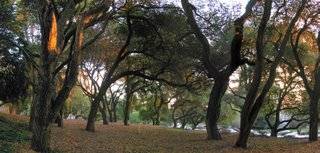
In Berkeley the University of California is planning to tear down a woodland grove of Coast Live Oaks (at least one estimated to be 200-300 years old), a massive Bay tree, and several Redwoods. And for what reason? To build a new sports training facility. Sure, that's what the world needs--fewer oaks, more jocks!
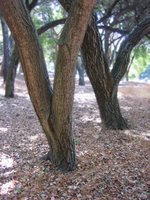 This urban forest is a well-established and thriving ecosystem. Normally, the Coast Live Oaks would be protected under the City of Berkeley's Live Oak Protection Ordinance, but because the university is a state institution, it has declared that it does not need to abide by the local ordinance.
An effort has sprung up to persuade the University of California to reconsider. There are at least two other sites that the university could consider for building this new sports facility, but without significant public pressure, it's doubtful that they will revise their plans and leave the oaks in place. If you're interested in joining a grass-roots citizens' campaign to protect this woodland, visit Save the Oaks at the Stadium to learn more and participate in their efforts.
Berkeley is a wonderful, weird place that feels like it's always teetering on the sharp edge between wonderland and an insane asylum. It really needs to hang on to every scrap of nature it can, just to keep it from spinning off the face of the planet.
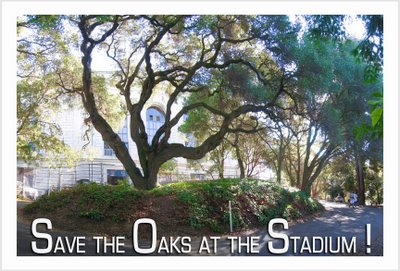

In Berkeley the University of California is planning to tear down a woodland grove of Coast Live Oaks (at least one estimated to be 200-300 years old), a massive Bay tree, and several Redwoods. And for what reason? To build a new sports training facility. Sure, that's what the world needs--fewer oaks, more jocks!
 This urban forest is a well-established and thriving ecosystem. Normally, the Coast Live Oaks would be protected under the City of Berkeley's Live Oak Protection Ordinance, but because the university is a state institution, it has declared that it does not need to abide by the local ordinance.
An effort has sprung up to persuade the University of California to reconsider. There are at least two other sites that the university could consider for building this new sports facility, but without significant public pressure, it's doubtful that they will revise their plans and leave the oaks in place. If you're interested in joining a grass-roots citizens' campaign to protect this woodland, visit Save the Oaks at the Stadium to learn more and participate in their efforts.
Berkeley is a wonderful, weird place that feels like it's always teetering on the sharp edge between wonderland and an insane asylum. It really needs to hang on to every scrap of nature it can, just to keep it from spinning off the face of the planet.

Subscribe to:
Posts (Atom)
