There's nothing that will launch you more exuberantly into Spring than a visit to the SF Flower & Garden Show, which opens today. I'll be there this afternoon, and tomorrow, and Friday, and.... Well, we'll see. There are seminars I'd like to attend every day, in addition to checking out the display gardens, cruising the exhibitor booths, and, of course, buying plants. The show runs through Sunday and I hope you'll check it out. It is always great fun and very inspiring. Check back here later in the week for photos I'll be posting.
Tweet
Pin It

Wednesday, March 21, 2012


Sunday, March 04, 2012
You Can Grow That!: Cymbidium Orchids

Garden writer and blogger C.L. Fornari has had the brilliant idea of initiating You Can Grow That! Day. The idea is that on the 4th of each month, garden bloggers will put up a post about a plant they want to encourage people to grow. What I like about this idea is that all of us have a secret list of plants that we really want to grow but think we won't be able to. But gardening really should be a fearless endeavor, and in that spirit, here is my first You Can Grow That! post:
My grandmother grew the most beautiful cymbidium orchids I've ever seen. In the late winter and early spring she'd bring us enormous sprays of orchids in shades of green and yellow and purple. I know now that she grew them under conditions that most professional growers would not approve of, but surprisingly she managed to give those orchids exactly what they needed.

Unlike many of the other orchids most people are familiar with, cymbidiums are semi-terrestrial, meaning they are happier in well-draining, loamy soil rather than in plain bark chips like the tree-dwelling orchids. A good mixture is loose potting soil mixed with perlite, small bark chips, and peat (for acidity).
Cymbidiums like bright filtered light (full sun in winter is acceptable). They can can grow well outside and are naturally suited to cold weather but must be protected from both frosts in the winter and full sun in the summer. Keep the plants moist but you can allow them to become a little drier between waterings when blooming. Apply a weak solution of a liquid balanced fertilizer every one to two weeks. The leaves should be a bright apple green; if they are darker, cut back a bit on the feedings.
Flower spikes will appear in the winter and last for several weeks. When the flowers are spent, cut the spike off at the base.
You shouldn't need to repot your cymbidium orchids until the pot has become very crowded or the potting mix has deteriorated. They like to be somewhat pot-bound so you shouldn't have to divide them for several years. When you do, take out the dried-up bulbs, but leave the green leafless bulbs attached. Those green bulbs won't flower for several years and the plant will meanwhile use the bulbs for water storage.
So that's the professional wisdom on growing cymbidiums. Now I'll tell you how my grandmother did it. She planted her orchids right in the ground where they got full sun in the morning but were somewhat shaded in the afternoon. And everyday, she threw her used coffee grounds on the soil around them. With Alameda's sandy, fast-draining soil and moderate temperatures and the coffee keeping the pH level at a nice slightly acidic level, she managed to give those orchids the perfect home.
I've kept one cymbidium in a pot on my deck for the past few years and I've just bought another one. As soon as the blooms are spent, I'm going to plant them in the same bed where I'm growing some fuchsias and a big papyrus. And from then on I'll be caring for them grandma-style.
Tweet Pin It
Monday, February 27, 2012
Somewhere a Hummingbird Is Snoring
Seriously. I knew that hummingbirds can actually be quite loud. In my garden they are second only to the crows in making a ruckus. But I never imagined that they snore. Or that if they snored, it would be this loud. I suppose it's no surprise that this little birdie is sleeping alone. The sound completely freaked out my cat. Birds everywhere are probably wondering when Breathe Right is going to make some strips small enough to go across those little beaks. Enjoy:
Tweet Pin It
Tweet Pin It
Thursday, February 23, 2012
All the Edible Gardening News That's Fit to Pin
Want a great place to go to find an ever-growing collection of articles on growing edibles? Follow the Vegetable Garden Bloggers & Writers United board on Pinterest. With more than 20 garden writers (including me) contributing their posts on vegetable gardening, you'll discover a wide selection of topics and very solid information from people who never get tired of exploring the world of edible gardening.
I've written about the fun I'm having with Pinterest before. If you'd like to follow my boards, click the following button.

Tweet Pin It
I've written about the fun I'm having with Pinterest before. If you'd like to follow my boards, click the following button.
Tweet Pin It
Wednesday, February 22, 2012
Can Your Soil Pass the Acid Test?
I've been clearing out a bed this week that I intend to plant with a mix of ornamentals and edibles, the main feature of which will be two or three blueberry bushes. Blueberries, like a great many other edibles, are acid-loving plants and I wasn't sure my sandy soil would measure up (or down, as the case may be). It was time to do a little testing to see what the pH level of my soil is.
Don't get scared off about soil tests and pH levels. This isn't rocket science--it's not even as hard as high school chemistry. pH is simply a measure of acidity and alkalinity using a scale that runs from 0 to 14. The midpoint, 7, is considered neutral. Below 7 all the way to 0 indicates increasing acidity. Above 7 up to 14 indicates increasing alkalinity (also called basicity). The soil pH level matters because essential nutrients in the soil are most available to plants when they are in the proper pH environment--with 5.5 to 6.5 being the most commonly appropriate range.
 Testing your soil's pH level is a simple and inexpensive process. I purchased a soil test kit produced by Ferry-Morse at my local hardware store for $4.99. The kit tests pH level as well as macronutrient levels (nitrogen, phosphorous, and potassium), which I'll test separately at a later date. For the pH test, all you have to do is take a small sample of soil from 4 inches below the soil line, put it in the test tube with the green cap, open the green capsule and pour the contents on top of the soil, then fill it with water, cap and shake, and let sit for a minute. Very quickly, the soil settles in the tube and the water on top of it turns a color that you can match to the color scale on the package.
 It doesn't show very well in this photo but my soil tested somewhere between 7.0 and 8.0, indicating that the soil is quite a bit more alkaline than the range that blueberries want (4.5 to 5.5). These simple home test kits don't give you a very exact reading, but it's enough to head you in the right direction in terms of how to amend your soil. If you want a more exact reading, check out the standard soil test you can have done by mail at the University of Massachusettts for only
 $10. (2015 Update: This test now costs $15).
Most edibles prefer somewhat acidic soil. Here's a sample of some of the acid-loving fruits and veggies you may be growing that might need some tweaking of their soil pH:
Avocados--6.0-6.5
Bananas--5.5-6.5
Blueberries--4.5-5.5
Brambleberries--6.0-6.5
Brussels sprouts--5.5-6.5
Citrus--6.0-7.5
Guava--5.0-7.0
Kiwi--5.0-6.5
Melons--6.0-6.5
Pomegranate--5.5-7.0
Potatoes--5.0-6.0
Rhubarb--6.0-6.8
Strawberries--5.5-6.5
Sweet potatoes--5.0-6.5
Turnips--5.0-6.5
In addition, ornamentals such as roses, azaleas, rhododendrons, camellias, begonias, and most bulbs are just a few of the flowers that like acidic soil.
So once you determine your pH level, what do you do? If you need to make your soil more alkaline (or basic), the amendments that are most commonly added are agricultural lime and wood ash. If you need to make your soil more acidic, most people add peat, but pine needles, pine sawdust, and coffee grounds will also do the trick. It takes time to measurably adjust the pH level of your soil, but providing the right pH environment should make a noticeable difference in the health of your plants and the harvest that results.
Tweet Pin It
Don't get scared off about soil tests and pH levels. This isn't rocket science--it's not even as hard as high school chemistry. pH is simply a measure of acidity and alkalinity using a scale that runs from 0 to 14. The midpoint, 7, is considered neutral. Below 7 all the way to 0 indicates increasing acidity. Above 7 up to 14 indicates increasing alkalinity (also called basicity). The soil pH level matters because essential nutrients in the soil are most available to plants when they are in the proper pH environment--with 5.5 to 6.5 being the most commonly appropriate range.
 Testing your soil's pH level is a simple and inexpensive process. I purchased a soil test kit produced by Ferry-Morse at my local hardware store for $4.99. The kit tests pH level as well as macronutrient levels (nitrogen, phosphorous, and potassium), which I'll test separately at a later date. For the pH test, all you have to do is take a small sample of soil from 4 inches below the soil line, put it in the test tube with the green cap, open the green capsule and pour the contents on top of the soil, then fill it with water, cap and shake, and let sit for a minute. Very quickly, the soil settles in the tube and the water on top of it turns a color that you can match to the color scale on the package.
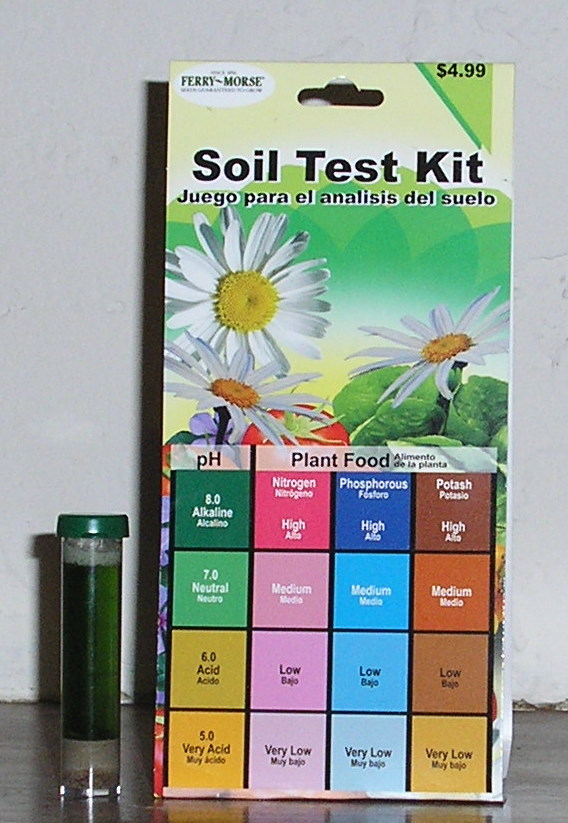 It doesn't show very well in this photo but my soil tested somewhere between 7.0 and 8.0, indicating that the soil is quite a bit more alkaline than the range that blueberries want (4.5 to 5.5). These simple home test kits don't give you a very exact reading, but it's enough to head you in the right direction in terms of how to amend your soil. If you want a more exact reading, check out the standard soil test you can have done by mail at the University of Massachusettts for only
 Most edibles prefer somewhat acidic soil. Here's a sample of some of the acid-loving fruits and veggies you may be growing that might need some tweaking of their soil pH:
Avocados--6.0-6.5
Bananas--5.5-6.5
Blueberries--4.5-5.5
Brambleberries--6.0-6.5
Brussels sprouts--5.5-6.5
Citrus--6.0-7.5
Guava--5.0-7.0
Kiwi--5.0-6.5
Melons--6.0-6.5
Pomegranate--5.5-7.0
Potatoes--5.0-6.0
Rhubarb--6.0-6.8
Strawberries--5.5-6.5
Sweet potatoes--5.0-6.5
Turnips--5.0-6.5
In addition, ornamentals such as roses, azaleas, rhododendrons, camellias, begonias, and most bulbs are just a few of the flowers that like acidic soil.
So once you determine your pH level, what do you do? If you need to make your soil more alkaline (or basic), the amendments that are most commonly added are agricultural lime and wood ash. If you need to make your soil more acidic, most people add peat, but pine needles, pine sawdust, and coffee grounds will also do the trick. It takes time to measurably adjust the pH level of your soil, but providing the right pH environment should make a noticeable difference in the health of your plants and the harvest that results.
Tweet Pin It
Thursday, February 16, 2012
Gary Oppenheimer on "Changing the Way We Eat"
On January 21st in Manhattan, Gary Oppenheimer, founder of AmpleHarvest.org, spoke at a TEDx event on the subjects of our food system, hunger in America, and the difference that a home gardener can make. Give a listen to this inspiring and thought-provoking presentation:
Tweet Pin It
Tweet Pin It
Wednesday, February 15, 2012
Bringing Back the Blogroll
Sometime in the past couple years, the blogroll I used to have here that
linked to my favorite garden blogs disappeared. I think I took it down
with the intention of updating it and bringing it back, and well, it
just stayed down. But it's time to bring it back. There are some great
blogs out there that have amazing ideas for your garden and lots to say
(sometimes with lots of attitude) about gardening in general. So check
out my new, updated, two-part blogroll--one part listing California
blogs and one part listing blogs from everywhere else. (You'll find it
located in the middle column.) I guarantee you'll find some great
writing and lots of inspiration to keep your garden exciting and always
evolving.
Tweet Pin It
Tweet Pin It
Subscribe to:
Posts (Atom)
