An Alameda Garden: daffodils
Showing posts with label daffodils. Show all posts

Wednesday, April 10, 2013

How to Handle Daffodil Bud Blast

First, you cry.

You've waited through months of cold and rain with one thought in your mind: there will be daffodils. Eventually. There will be daffodils. And then, finally, there are daffodils. A few. But what there are a whole lot of are leaves and stems topped by brown, papery, dead-looking buds that never open.

You've just been bud-blasted.

It happened to me this year. And I was so ashamed! I thought I must have done something wrong. Most of my daffs have been in the ground for several years and aside from dutifully letting the leaves die down after blooming before I clear them away, I haven't done anything with them. I've added some compost now and then, but no special soil amendments. So I figured my neglect was probably the cause of these dead-on-arrival buds.

But after a bit of research, I've found that there could be some other reasons why my daffs suffered this fate. According to the American Daffodil Society, while lack of feeding may be to blame, other possibilities are not enough sun (they need at least a half-day of sun to set a bloom), unusual weather (heat waves or excessive rain) the previous spring when the bulb would have been forming the next flower, or a need to divide the bulbs if they've been in the same place for more than a few years. There are other possible causes having to do with planting or even viruses, but they don't seem to apply to my particular bulb problem.

So here's my plan for beating bulb blast next year:
  1. I'm applying a low-nitrogen, high-phosphorus and potassium fertilizer now, while the bulb is getting ready to produce the bloom for next year. (The ADS recommends a 5-10-10 fertilizer.)
  2. I'm leaving the leaves and stems in place until they die back naturally. I usually tie them into bundles with string or rafia to keep them tidier and to keep me from yanking them out when I'm weeding.
  3. After the greens have died back completely I'm going to dig up ALL the bulbs and check them for signs of disease or decomp. Any mushy bulbs will get tossed. I'll divide the bulbs as needed and store them until the fall somewhere cool and dry. (I keep those plastic mesh bags that onions and other vegetables are sometimes sold in in the stores for just this purpose. They keep the bulbs together but still allow air circulation around them.)
  4. In the fall, I'll replant the bulbs in a different part of my garden where they're going to get better sun exposure. The bed that I had them in is now more shaded by a growing tree than it used to be. I'll feed them again at the time of planting.
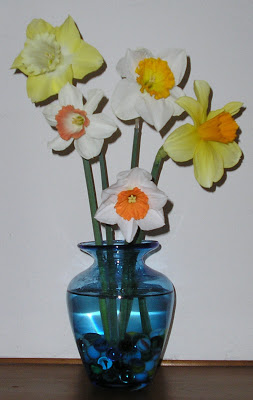
With any luck, next year I'll be rewarded with the full range of daffodil blooms I've enjoyed in the past.


Thursday, February 07, 2013

Gardening Events on the Horizon

You know the new year has really started in earnest for gardeners when the calendar starts to fill up with not-to-be-missed gardening events. Well, that time has arrived. Here are just a few of the happenings in the Bay Area that I'm looking forward to in the coming months:

  • The Pacific Orchid Exposition (Feb. 21-24) at Fort Mason in San Francisco. This is always a mind-blowing experience just for the sheer number and variety of orchids gathered in one place. But this year should be even more amazing due to the addition of a series of seminars running throughout the show. This will allow you to not just ogle the beautiful orchids, but really learn a good deal more about them. (Note: You can save a few dollars on admission by buying your tickets in advance online.)
  • Daffodil Daydreams/Opening Celebration at Filoli (Feb. 22-24) in Woodside. Come to admire the profusion of daffodils and other spring blooms in the amazing setting that is Filoli. Stroll, attend lectures, sup in the cafe. It's a feast for the senses.
  • Growing Organic Tomatoes talk at Evergreen Nursery (Mar. 9, 1 p.m.) in San Leandro.  I'll give an hour-long presentation on growing great-tasting, chemical-free tomatoes and will also be signing copies of my book, California Fruit and Vegetable Gardening afterward. The event is free and Evergreen Nursery is a terrific nursery you may not know about yet. Come join us!
  • The San Francisco Flower & Garden Show (Mar. 20-24) at the San Mateo Event Center. This is the grand-daddy of all Bay Area garden events and a great opportunity for learning, shopping, and planning your next gardening projects. (Note: Save money on Early Bird tickets purchased before Mar. 11.)
I'll post more events as I find out about them, and starting in April and May there will be many garden tours going on, so keep your calendar open!

Tuesday, April 29, 2008

Propagation Month, Day 27: Scaling Daffodil Bulbs

Most people know that daffodil bulbs will "naturalize," meaning that they will multiply in the ground, each bulb adding one or two more each year. But there is another way to increase your bulbs--a process called scaling in which you slice the bulb into sections that will then form bulblets. Bulbs produced through scaling will take two or three years to flower, but you can potentially produce more bulbs through scaling than through naturalizing.

To scale a bulb, begin by clipping off the roots, taking care not to damage the bottom of the bulb, which is called the basal plate. Using a sharp paring knife, cut off the stem tips of the bulb. Then, starting your cuts at the basal plate, cut the bulb into sections lengthwise. Depending on the size of the bulb (I'm using the small tete-a-tete daffodil bulbs here), you can usually cut them into quarters or eighths. Make sure that each piece has some of the basal plate attached. If the basal plate becomes detached, throw out that piece--it won't form bulblets without it.

Pull out the center part of the bulb section--this is the actual flower stem and it will be discarded. Then, using the knife, separate the remaining part of each bulb section into two-scale sections, each with a piece of basal plate attached. If the scales are so thin that you can't separate all of them, that's probably OK, but you want to get as many two-scale sections as you can. The bulblets will grow between the two layers of scales.

Put the scales into a Ziploc bag filled with moist vermiculite. Gently distribute the vermiculite around the scales so that they're well-covered. Seal the bag and put it somewhere warm. You'll need to check it every so often for rot--if any of the scales look funky, discard them. The bulblets should form in about 8 to 10 weeks. The bulblets can then be potted up with each scale tip just above the surface. The bulbs should leaf out the following spring, but will need another year or two to flower.

Add to Technorati Favorites

Wednesday, March 05, 2008

A Daffodil Sampler


I'd forgotten that I've been adding a few varieties of daffodils over the last three years. The little tete-a-tete daffs have already bloomed out, but most of the rest are in bloom now and there are enough to enjoy outside as well as enough to cut for inside. Still to bloom are the pink daffs I planted last year. I can't wait to see how they turn out!

Add to Technorati Favorites

Thursday, March 15, 2007

Bloom Day

If this is the 15th, this must be Bloom Day. Here's a sample of what's blooming in the garden right now:

Jasmine

Tete-a-Tete Daffodils

Petunia

Kangaroo Apple

Aloe vera

Freesias

Professor Einstein Daffodil
Related Posts Plugin for WordPress, Blogger...